

Diego Mac is a Brazilian artist, dance director, choreographer, dancer, video and 3D artist, producer and cultural manager. His practice moves between dance, popular culture, images, technology, creativity and new forms of artistic production. In recent years, he has focused on exploring the relationship between dance, 3D animation and simulation, blockchain, metaverses and NFTs, investigating how dance can develop within new digital environments. Mac has worked in the cultural and entertainment field for more than 25 years, contributing to more than 300 artistic and cultural projects. He is director of Macarenando Dance Concept and artistic director of Muovere Dance Company. He holds a degree in Dance and a Master’s degree and specialisation in Visual Poetics, and is currently a doctoral researcher in Performing Arts. His work has been presented internationally, including at NFT.NYC, and has received more than 20 awards. In 2022, he received the Açorianos de Dança Award for Personality of the Year for his innovative work in 3D dance, as well as the Cultural Trajectories Award in recognition of his artistic practice.
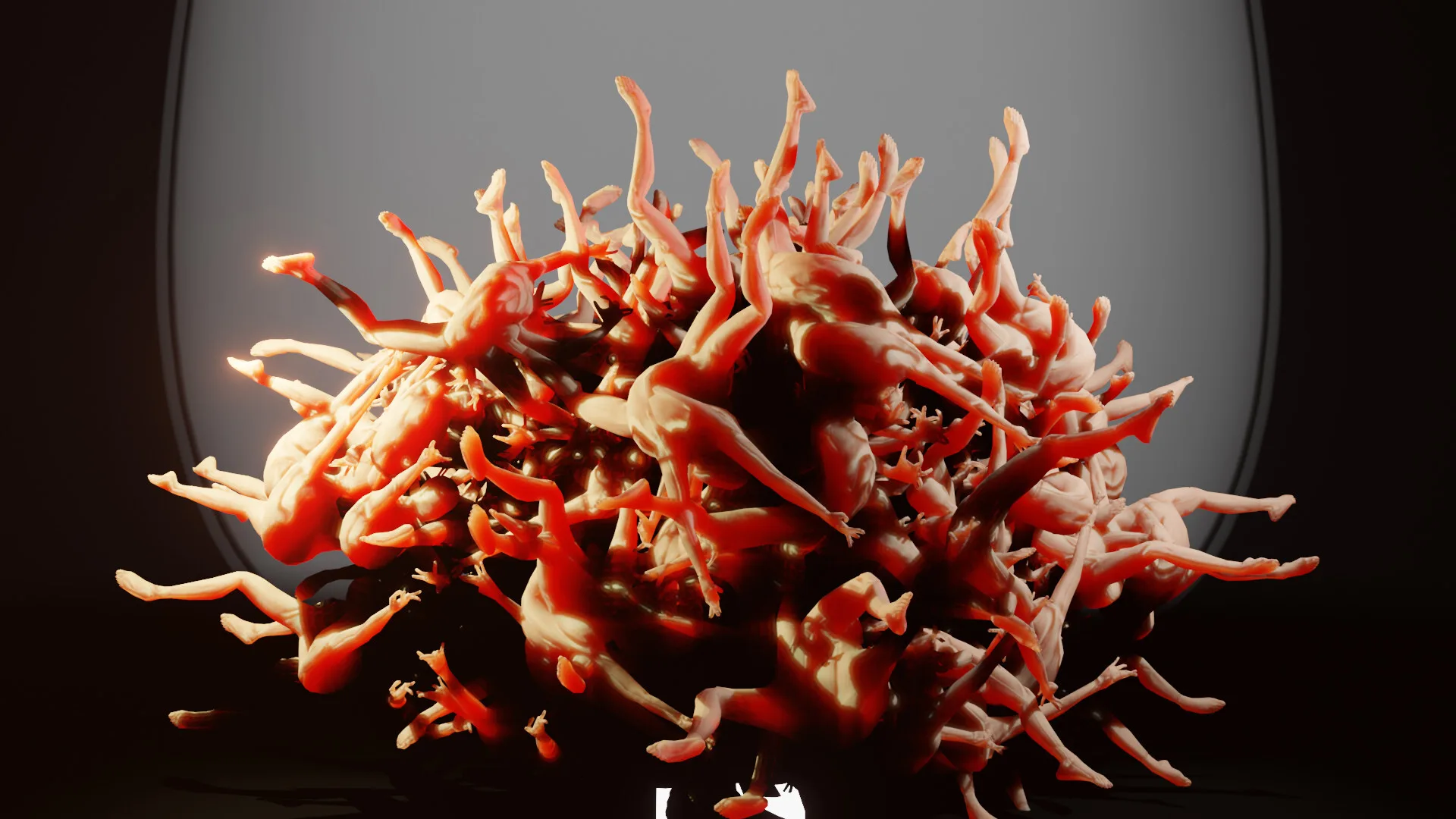
Sylphides 3.1 is part of a collection of videos in which Diego Mac hybridises dance with 3D animation and simulation. The title refers to La Sylphide (1832) and Les Sylphides (1909), works that established the sylph as one of ballet’s most enduring figures: romantic, airy, vaporous, enigmatic and superhuman. In Mac’s digital version, however, the feminine sylph gives way to androgynous figures that are neither male nor female, but decentralised, hyperflexible and constantly transforming. Bodies with soft parts, simulated physics, disjointed movements and procedural choreographies. Hyperhumans. Diverse bodies. Various dances.
In Sylphides 3.1, 200 embryonic sylphs move as a single collective ballet body. Elements of dance language—the waltz, circles, turns, points of support and control, joint mobility and the relationship with gravity—are subjected to the logic of 3D animation: soft and plastic bodies, fluids, winds, low gravity, and expanding and contracting force fields. Classical ballet is broken apart and reassembled through a digital body, raising the question of how dance might begin again in a new language, and what happens when the body is no longer bound by the same physical rules. Accompanying the digital sylphs is a historic recording of Les Sylphides from 1916, bringing the past and future of dance into the same four-minute space.