

Marc Downie, Paul Kaiser and Shelley Eshkar work together as OpenEndedGroup, an artistic collective that has explored the intersections of art, computer technology, movement and generative systems since the late 1990s. Their work often emerges from data, algorithms and real-time computation, exploring how computational systems can become active collaborators in visual and performative practices.
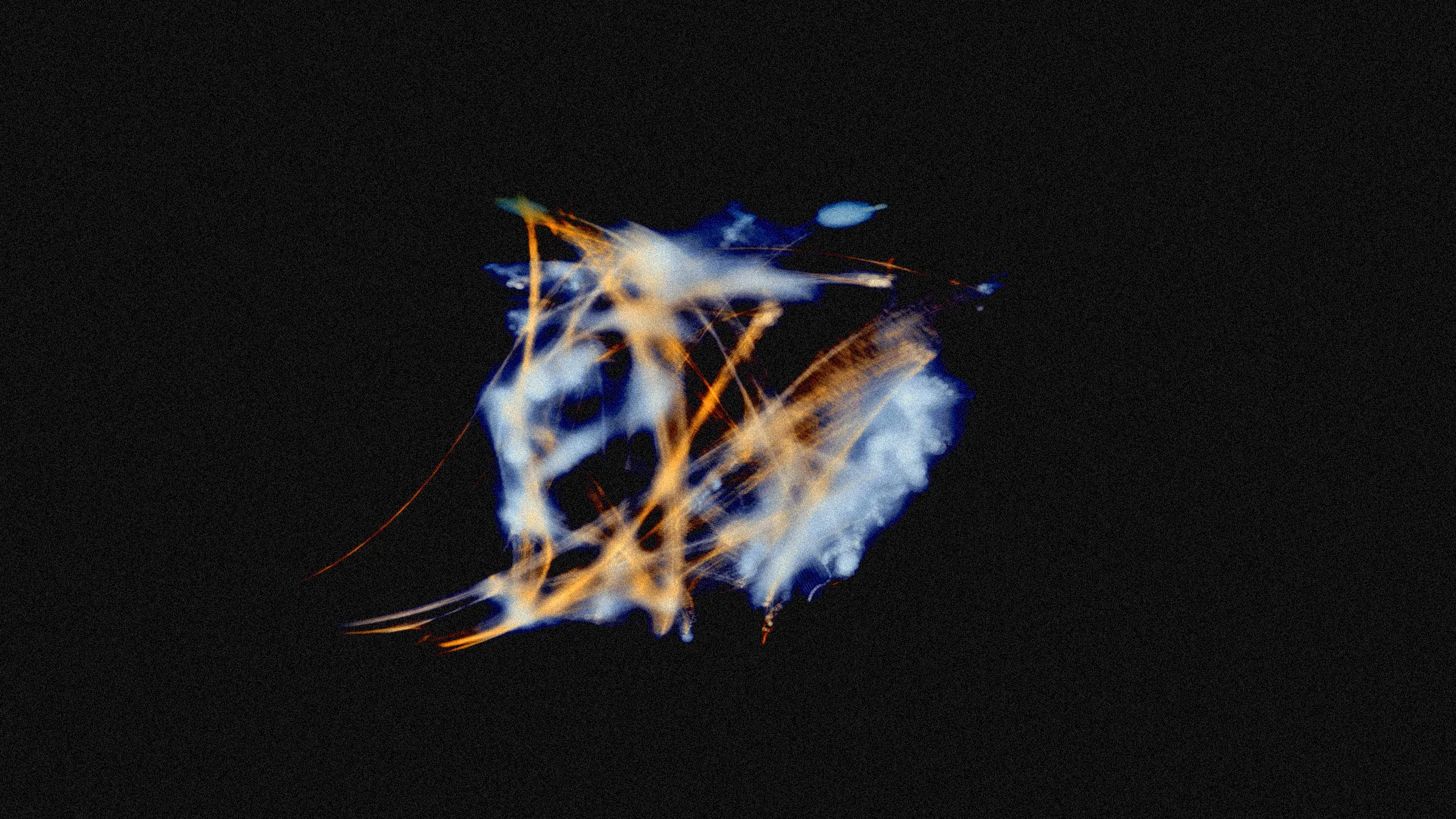
Loops is an abstract digital portrait of legendary American choreographer and dancer Merce Cunningham. Rather than capturing his face or body, it captures his movement: motion-capture data from Cunningham’s solo for hands and fingers is transformed into a dynamic network of nodes that continually connect, dissolve and reconfigure. The digital image thus emerges directly from the choreography—a visualisation of movement that is never quite the same twice.
In the VR version, Cunningham’s abstracted hands become almost tangible. Networks and lines move directly in front of the viewer’s gaze, their flickering forms evoking organic structures, fire or microscopic life. The sound is generated from Cunningham’s own material: his voice, reading diary entries about his first visit to New York in 1937, drives a musical structure based on the logic of John Cage and his prepared piano.
Loops is also a work about the digital preservation of choreography. Both Cunningham’s dance and its digital interpretation were conceived as living systems that change with every performance. The creators therefore released the motion-capture data and underlying software as open source, while the choreography was published under a Creative Commons licence. Rather than a fixed record, Loops becomes a living archive—a work that can be studied, performed, modified and reactivated in the future.
The work was developed in collaboration with Merce Cunningham and his dance company. Motion capture of his solo for the hands was recorded in 2000, and the first version of the digital work was created in 2001 as a commission from the MIT Media Lab. The project subsequently evolved through several versions, including presentations at Ars Electronica and the New York Film Festival. In 2015, the work was acquired by the Museum of Modern Art (MoMA) in New York for its permanent collection.